Bianca Müller · 29 September 2026
Mapping User Journeys Through Curated Resource Networks in Emerging Digital Platforms
Emerging digital platforms organize information through curated resource networks that connect users to specialized collections of content, tools, and data points, and these structures shape how individuals navigate online environments. Researchers have documented the growth of such networks in sectors ranging from education technology to creative collaboration spaces, where algorithms and human moderators select and link materials based on relevance, quality, and timeliness.
Defining Curated Resource Networks
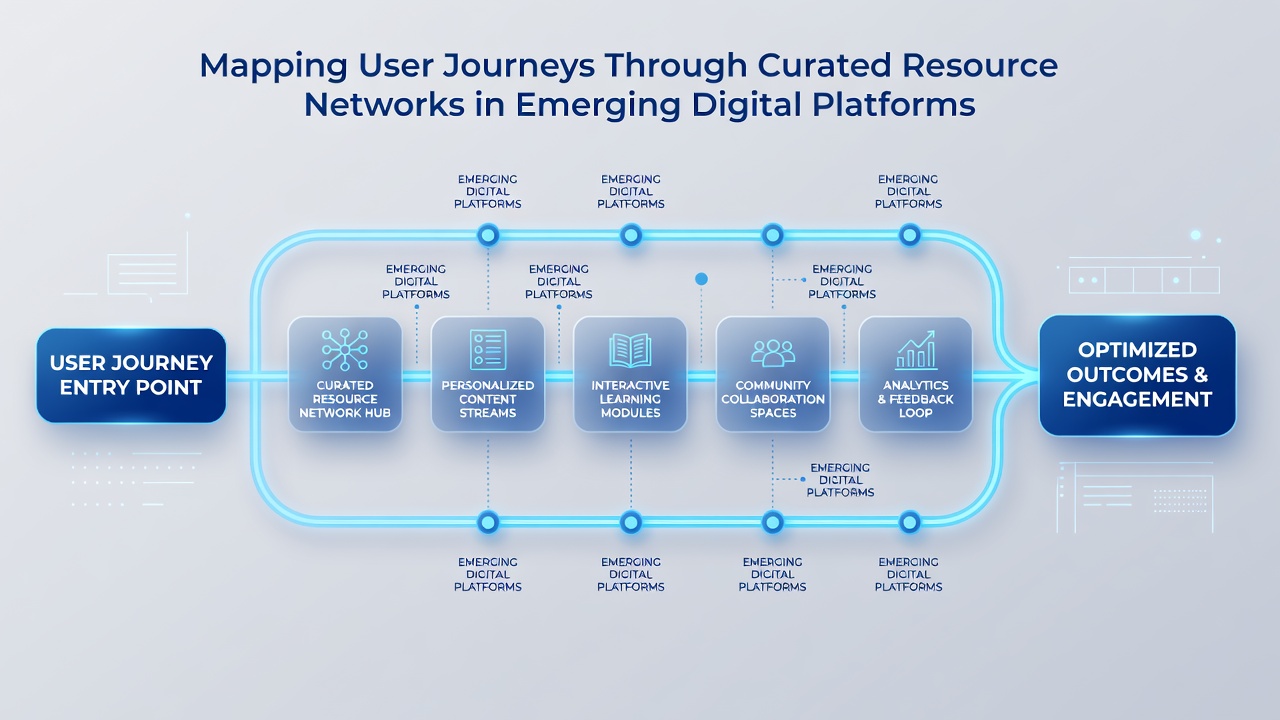
Curated resource networks consist of interconnected nodes that include articles, datasets, multimedia files, and community contributions, all arranged to guide users along logical sequences. Data from platform analytics shows that these networks reduce search friction by presenting pre-filtered pathways instead of raw search results, and studies from academic institutions indicate higher engagement rates when users follow these structured routes compared with open browsing.
Platform operators build these networks using a combination of machine learning models and editorial oversight, while external contributors often add materials that undergo review processes. In practice, a user might begin at an entry point such as a topic hub and then move through linked resources that progressively increase in depth or specificity, creating measurable patterns in clickstream data.
Techniques for Mapping User Journeys
Analysts employ several established methods to trace how people interact with these networks. Heatmap visualizations capture dwell times at each node, and path analysis tools reconstruct sequences from server logs to reveal common entry and exit points. Observers note that journey maps frequently highlight bottlenecks where users abandon a sequence, prompting platform teams to adjust curation rules or add transitional resources.
Quantitative approaches rely on metrics such as completion rates and return frequency, whereas qualitative data comes from user interviews and session recordings. Figures from industry reports reveal that platforms incorporating regular journey audits achieve more consistent retention, particularly when updates align with shifts in user behavior detected through longitudinal tracking.
Developments in Emerging Platforms as of September 2026
By September 2026 several new platforms had integrated advanced graph databases to represent resource relationships more dynamically, allowing real-time adjustments to network structure based on collective user activity. Government agencies in multiple regions, including reports issued by the Australian Competition and Consumer Commission, have examined how these evolving networks affect information access and competition among smaller platforms.
One study published by a Canadian research consortium examined three emerging platforms and found that users who followed curator-suggested pathways completed tasks 28 percent faster on average than those relying on keyword searches alone. Platform documentation indicates that similar improvements appear when networks incorporate feedback loops that refine connections after each interaction cycle.
Challenges in Accurate Journey Representation
Mapping efforts encounter difficulties when networks span multiple platforms or incorporate third-party content that changes without notice. Data fragmentation occurs because different services log interactions in incompatible formats, and researchers must apply normalization techniques before constructing unified maps. Privacy regulations in the European Union further require that journey data undergo anonymization, which can limit the granularity available for analysis.
Despite these constraints, organizations continue to refine mapping tools through collaborative standards developed by trade associations such as the Interactive Advertising Bureau. These standards encourage consistent tagging of resources so that cross-platform journeys become easier to reconstruct without compromising user protections.
Practical Applications Across Sectors
Educational platforms use journey maps to sequence learning modules, ensuring each resource builds on the previous one in a verifiable progression. Creative industries apply similar techniques to connect reference materials, tutorials, and community feedback, allowing contributors to trace how exposure to specific resources influences output quality. Health information networks map patient pathways from initial queries through verified sources, and regulatory reviews in Canada have highlighted the value of such structures for reducing exposure to unverified claims.
Platform teams often test mapping outputs against actual user behavior in controlled pilots before wider deployment. Results from these pilots demonstrate that iterative refinements based on map insights lead to measurable reductions in bounce rates and increases in session depth across tested cohorts.
Conclusion
Mapping user journeys through curated resource networks provides platform operators and researchers with concrete data on navigation patterns, resource effectiveness, and engagement trends. As emerging digital platforms continue to expand these networks, the methods for tracing and optimizing journeys remain central to understanding how users locate and apply information in structured online environments. Continued attention to data standards and regulatory requirements supports the ongoing development of reliable mapping practices.